Roma's transfer activity over the summer has reinforced the club's historic connection with Argentina, adding Paulo Dybala and Matías Soulé to three further Argentine arrivals: Nahuel Molina, Santiago Castro, and Leonardo Balerdi. No nation has been represented more heavily in Roma's history than Argentina: 41 Argentine players have worn the giallorossi shirt since the club's foundation in 1927.
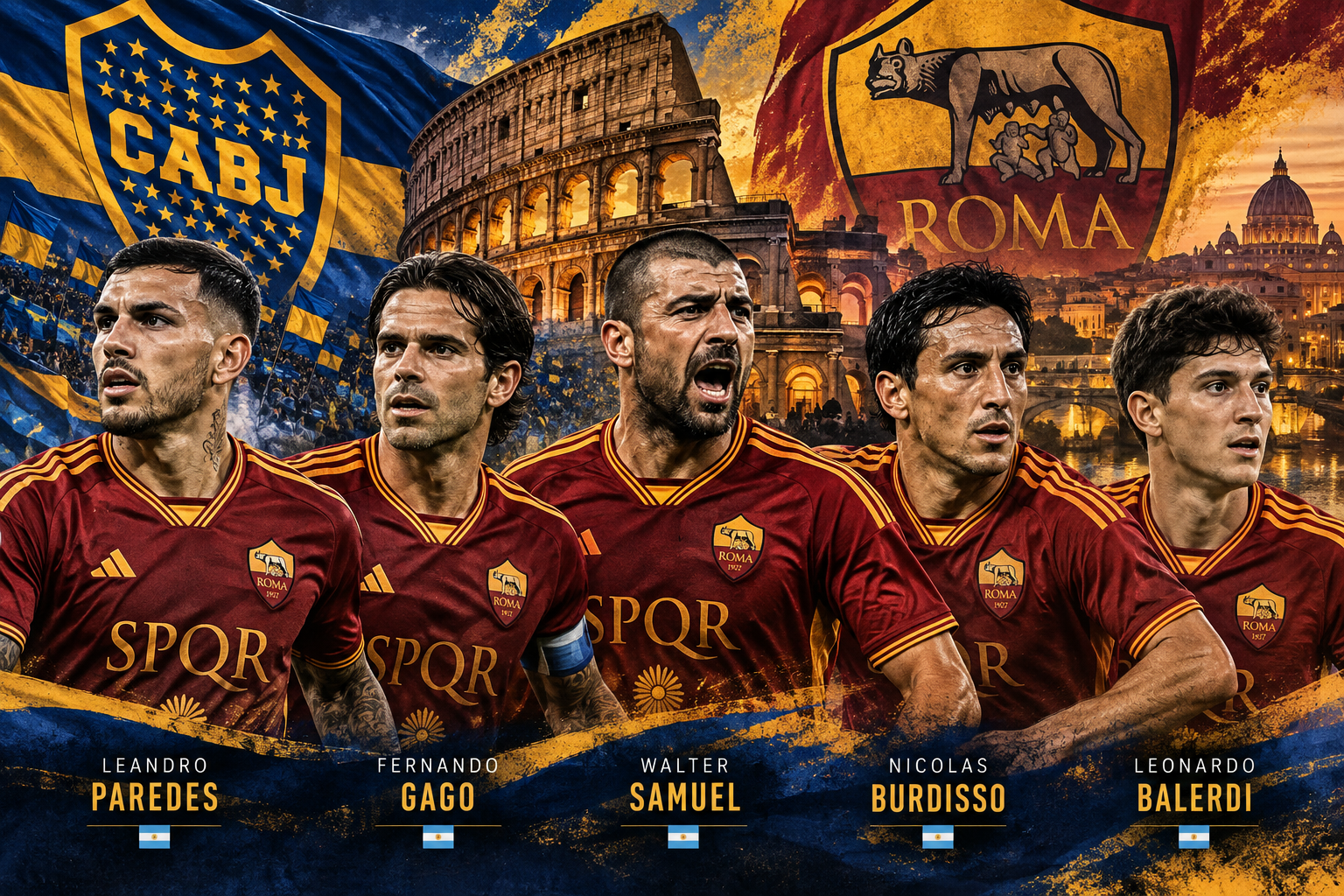
A secondary pattern, particularly pronounced from the 1990s onwards, links Roma to Boca Juniors specifically. Many of the Argentine players Roma has signed since Caniggia's era wore the Boca shirt before joining Roma, and in several cases returned there to finish their careers. Caniggia himself spent four seasons at Boca after his Roma spell, recording 58 appearances and 22 goals. In the 1990s and early 2000s, other significant names followed: Abel Balbo, Gabriel Batistuta, and Walter Samuel. Batistuta scored 13 goals in 30 appearances for Boca before moving to Florence and then Roma. Samuel won the Copa Libertadores with Boca in 77 appearances and 4 goals, then joined Roma in the year of the club's last Serie A title in 2001 for 25 billion lire.
Other notable connections include Nicolas Burdisso and two midfielders central to Argentina's recent history: Fernando Gago, who made two separate moves between Roma and Boca with 70 appearances initially and 85 in his final stint before retirement, and Leandro Paredes, discovered by Sabatini at Boca and now returned to play at home. Diego Perotti played two loan matches at Boca from Sevilla before later joining Genoa and working with Gasperini. Molina was born and raised at Boca before transferring to Rosario Central.
Since Caniggia in the early 1990s, Roma has signed 24 Argentine players overall, of whom 10—almost half—came from or had spells at Boca Juniors. Daniele De Rossi, a Roma icon, also chose to spend his final year at Boca before retirement.
Testo Originale / Source Text
“La Roma e l’Argentina, un legame nuovamente rinsaldato dall’ultima campagna trasferimenti, nel corso della quale a Dybala e Soulè sono stati aggiunti tre argentini: Molina, Castro e in ultimo Balerdi.
Nessuna nazione è stata così tanto rappresentata nella storia della Roma: sono 41 i calciatori…”
Read the full article in Italian at Retesport.