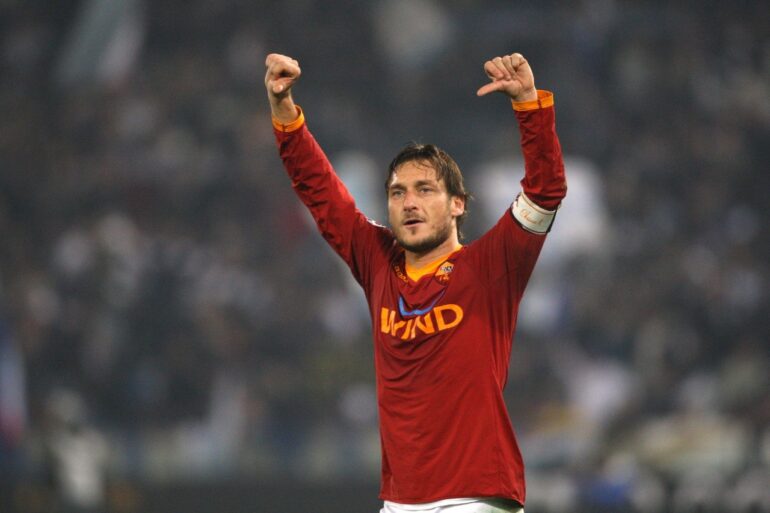
Francesco Totti turns 50 today, marking half a century for a figure who shaped Roma across nearly twenty-five years. For generations of Roma supporters, Totti became a constant calendar: present when fathers took their sons to the stadium, present through school, university, first jobs, marriages and children. Club presidents changed, coaches changed, teammates changed, opponents changed, even the stadium around him shifted—but the number 10 remained.
The depth of his connection to Roma transcends statistics, though the record stands: he played his entire career at the club, scored 307 goals total (250 in Serie A), won one Scudetto and two Coppa Italia titles among other honours. More profoundly, Totti represented Roma's greatest player, its captain, a piece of the city itself, and twenty-five years of collective memory. He demonstrated a personal philosophy of the game through technique that others could not see—a soft chip when everyone would have struck hard, a pass when the stadium demanded a shot, an apparently pointless back-heel that opened the field. In an era when football progressively transformed players into commercial entities, Totti made a choice that separated him from most: he stayed, despite knowing he could have won more elsewhere. That decision had a sporting cost but produced something money cannot buy—genuine belonging.
The complications of his story matter too. His final years brought tensions that reflected the impossible position of becoming larger than any manager, director or president passing through the club. Yet that fracturing formed part of his narrative as well. Today Roma continues naturally without him; new captains and new champions have arrived, and children now visit the stadium without having seen him play. But a number 10 shirt, a spoon gesture, or a mimicked sip of water from the thumb still speaks instantly across generations—not nostalgia, but collective memory.
Roma has fielded extraordinary players before Totti and will have others after. Few, if any, will represent simultaneously the club's finest player, its captain, a piece of its city and a quarter-century of their supporters' lives.
Story Coverage3 sources on this story
Francesco Totti turns 50 today, marking half a century for the man Roma considers its greatest player and most enduring symbol. Born in 1976, Totti played his entire career in the giallorossi shirt from his debut on 28 March 1993 until his retirement in 2017—twenty-five years of unbroken service that shaped collective memory for generations of Roma supporters. According to Forza Roma, he leaves behind 307 goals across all competitions and 786 appearances as Roma's all-time record holder in both categories; TeleRadioStereo reports 250 Serie A goals among his total. His honours include one Serie A title in 2001, two Coppa Italia crowns (2007, 2008), and two Supercoppa Italiana trophies (2001, 2007).
Beyond Roma, Totti represented Italy at Euro 2000 and the 2006 World Cup in Germany, where he played a central role in the Azzurri's triumph as world champions. His recovery from a serious ankle injury sustained in February 2006 enabled him to feature as a starter in his World Cup debut on 12 June against Ghana. TeleRadioStereo and Roma News emphasise that Totti's significance transcends statistics—he demonstrated a personal philosophy of football through technique that others could not replicate, and made the choice to remain at Roma despite knowing he could have won more elsewhere.
Roma News reports that Totti currently holds no formal position at AS Roma despite recent contact and attempts to bring him back into an official role. He serves as an adviser to Maxima Roma, a newly promoted basketball franchise, and has published an autobiography titled *Oltre*. Despite his absence from the club's structure, his influence endures: coach Gian Piero Gasperini has recognised the value of players developed in Roma's academy who carry genuine belonging to the shirt. Totti celebrates his milestone in Las Vegas with family.
AI synthesis of all sources below — always check the originals.
Testo Originale / Source Text
“Cinquant’anni. La cifra fa uno strano effetto perché Francesco Totti, per chi è cresciuto a Roma tra gli anni Novanta e Duemila, sembra appartenere a una dimensione nella quale il tempo si è fermato. Non per nostalgia, almeno non soltanto. Ma perché per quasi un quarto di secolo la Roma e Totti…”
Read the full article in Italian at TeleRadioStereo.